Securing Agentic Operations: OpenShell Meets OpenKubes
Secure execution is necessary. Governed Kubernetes operations and independent verification make it trustworthy.
OpenKubes Architecture · November 11, 2026 · Architecture exploration
Status: Architecture proposal — not an integration announcement. OpenKubes has not integrated or production-qualified OpenShell. ADR-Platform-042 is Proposed and technical validation is still pending. This article describes a target architecture and its required proofs, not a deployed end-to-end operation path.
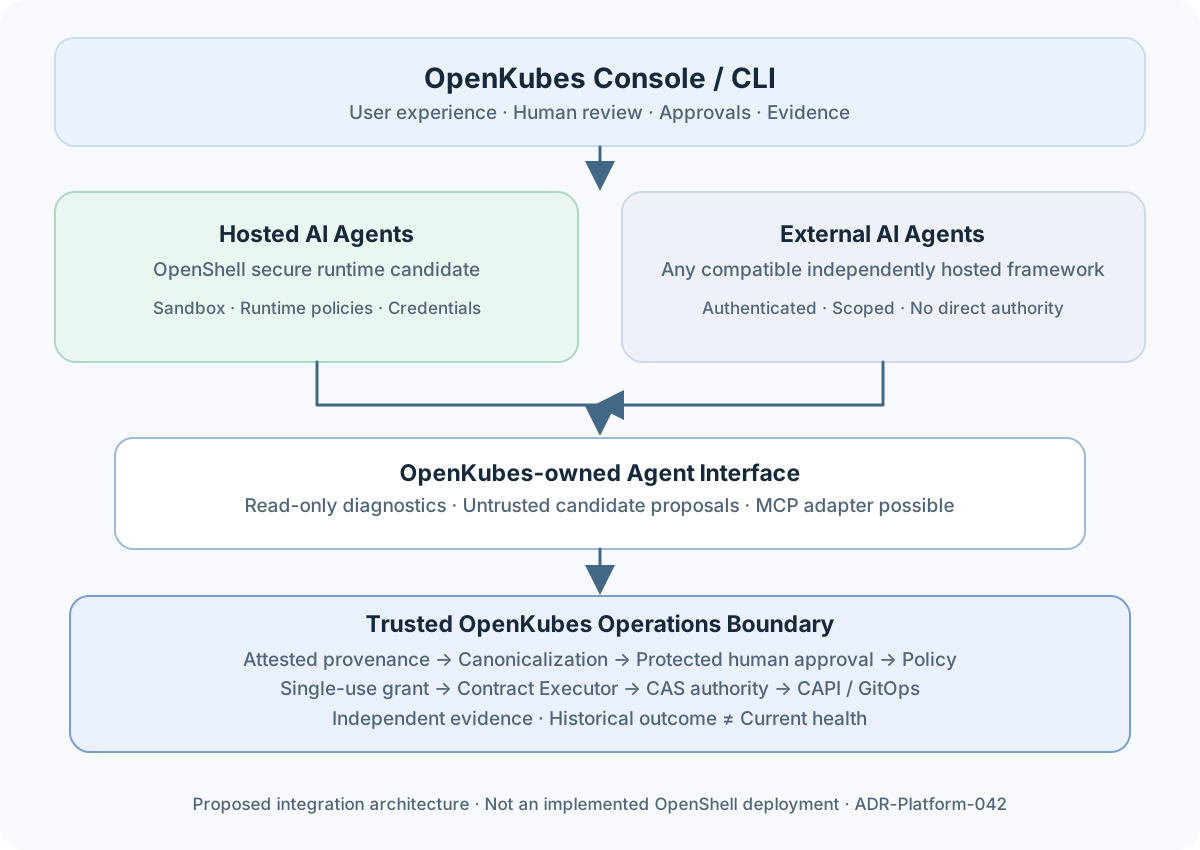
Two problems, two different trust boundaries
AI agents can read files, execute tools, call APIs and make useful recommendations. These capabilities also make them risky infrastructure clients. Prompt instructions are not a sufficient security boundary: access to credentials, networks, processes and platform APIs needs enforcement outside the agent.
OpenShell addresses the execution environment: sandbox isolation, runtime policy enforcement and controlled access to approved endpoints and credentials. Its maintainers describe these mechanisms in the upstream OpenShell repository. Its Kubernetes deployment and operational maturity still need assessment for our environment.
OpenKubes Agentic Operations addresses a different question: What may an agent ask the Kubernetes platform to change, who authorizes that change, and how is the outcome independently proven?
These concerns complement each other, but runtime isolation does not confer operational authority. A safely sandboxed agent can still propose an unsafe or incorrect change.
Our direction: hosted and external AI agents
We want OpenKubes to support both, without creating two governance models.
Hosted agents: a managed secure execution runtime
An OpenKubes-hosted agent could execute inside an OpenShell sandbox. OpenShell is our preferred candidate for the default hosted-agent runtime, subject to successful technical and security validation.
A hosted agent should be able to inspect approved read-only diagnostics, reason over platform context and submit a non-authoritative operation candidate. It must not inherit direct write privileges over Kubernetes, protected Git references, approvals, grants or the authoritative desired-state API.
External agents: bring your own framework
Organizations already run agents in many frameworks and trust domains. We do not want to require OpenShell for every external agent.
Instead, external agents should use authenticated, explicitly scoped OpenKubes interfaces and pass through the same candidate, review, authorization, execution and evidence path as hosted agents.
This keeps a useful design promise: any compatible agent can propose; only the trusted platform can authorize and execute.
The OpenKubes boundary: an agent proposes, a human approves
The proposed sequence is intentionally stricter than a generic agent-to-kubectl integration:
- An agent uses bounded, read-only diagnostics to understand the situation.
- It submits an untrusted candidate with authenticated, server-attested provenance.
- Trusted OpenKubes mechanisms validate and canonicalize the proposal against the authoritative predecessor revision.
- An authenticated human reviews and approves the exact semantic transition, not an AI-generated summary.
- An independent policy authority issues a transition-bound, single-use grant.
- A deterministic Contract Executor verifies the grant; the authoritative desired state is accepted through compare-and-swap semantics.
- Existing Kubernetes, CAPI and GitOps controllers reconcile the accepted state.
- Independent evidence establishes the historical transition outcome. Current health is tracked separately.
These are proposed end-to-end requirements, not a claim that all steps are implemented and proven today. Our Agentic Operations Reference Architecture documents the rationale and the current evidence gaps.
AI thinks. OpenKubes executes. Evidence proves.
Where CMCP fits — and where it must not
We are exploring CMCP/MCP as a bounded, replaceable way to make diagnostics and candidate operations accessible to agents. It is not a back door to Kubernetes mutation, a second policy authority, or an independent source of execution truth.
OpenKubes-owned versioned contracts remain authoritative; MCP can present those contracts to agents as an adapter. The choice between centralized and federated MCP architectures remains an open design question.
We also keep our existing Developer Workspace contract separate: a coding workspace and an operations agent may share isolation concepts but must not silently share privileges or lifecycle semantics.
OpenShell + Kyverno: defense in depth on Kubernetes
A CNCF platform-engineering guide published on November 11, 2026 describes another useful boundary: OpenShell runs its sandboxes through the Kubernetes Agent Sandbox API, while Kubernetes-native admission and network policies can independently constrain the resources used to run them.
In the Nirmata demonstration, Kyverno uses six validating policies and one mutating policy, written in CEL, to check Sandbox definitions and selected Kubernetes resources. These controls include non-privileged execution, restrictive OpenShell RBAC, limited workload egress, digest-pinned images, default resource requests, resource ceilings, and restrictions on injecting Kubernetes Secrets into Sandbox environment variables. Cilium enforces the Kubernetes NetworkPolicies; OpenShell's supervisor enforces finer-grained runtime restrictions such as permitted requests and credential handling.
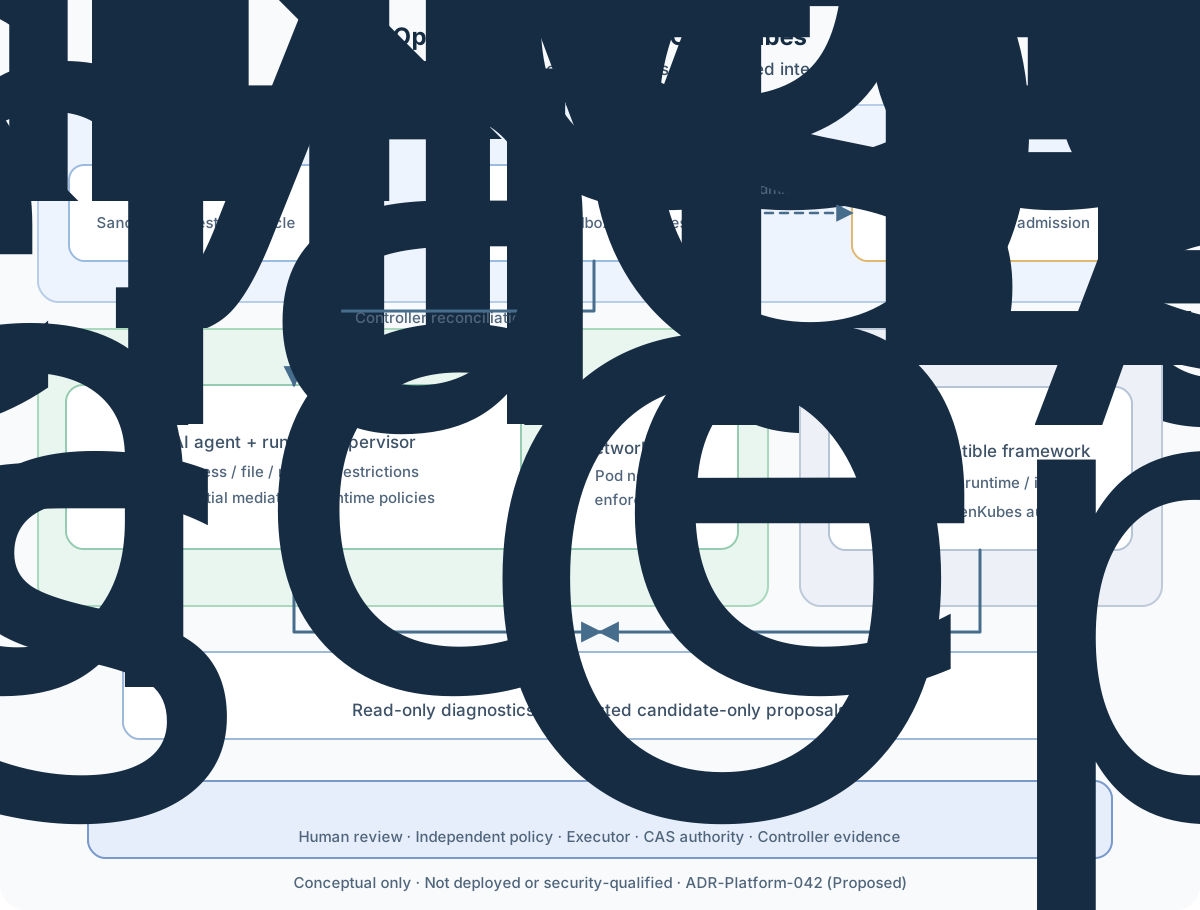
Conceptual OpenKubes architecture, adapted to the responsibilities discussed in the CNCF platform-engineering guide. It is not the KarsSandbox implementation shown in other community diagrams, nor a claim that this OpenShell/Kyverno/OpenKubes combination is running today.
These controls address distinct questions:
| Boundary | What it controls | What it does not prove |
|---|---|---|
| OpenShell | Agent execution, per-request runtime policies and credential mediation | Authorization to change OpenKubes desired state |
| Kyverno | Kubernetes resource admission, validation and mutation | That an agent-originated platform operation is approved |
| Cilium / NetworkPolicy | Pod network reachability | Application-level authorization or operation outcome |
| OpenKubes | Trusted proposal review, policy authorization, deterministic execution and independent evidence | The security of a runtime merely because it has passed admission |
The example is not a production security guarantee. The CNCF article explicitly notes that the gateway's ServiceAccount can still create Pods and NetworkPolicies directly; production hardening would need admission coverage for those objects too. Policy gaps involving credentials, tenant isolation and alternate network paths must be assessed rather than assumed closed. Kyverno is therefore a candidate reference admission-policy profile for OpenKubes-hosted agents, not a mandatory dependency or a replacement for other policy engines.
Our technical evaluation will include reproducing these policies in an isolated Kubernetes test environment, checking both expected admits and deliberate denials, testing bypass paths, and preserving the same candidate-only OpenKubes interface for external agents. Whether we adopt Kyverno alongside OpenShell will follow the evidence—not precede it.
Risk-based autonomy: who defines the boundaries?
A recurring question from the community is how AI agents could respond quickly in production without turning human approval into a bottleneck. Our proposed ADR-Platform-042 distinguishes approval latency from execution latency.
An asynchronous, durable review flow could let CMCP submit an untrusted proposal and allow an agent to disconnect or perform other work while trusted OpenKubes services handle review. A queued proposal is not an authorization, and CMCP is not the approval engine. Under our current proposed architecture, agent-originated state changes still require explicit human approval of the exact canonical transition.
Looking further ahead, different organizations may accept different levels of operational risk. We are researching policy-bounded autonomy: narrowly scoped, human-approved pre-authorizations with explicit owners, expiry, revocation, resource and tenant limits, replay protection, and independent evidence. This is research, not an implemented capability or an approved exception to the existing human-approval requirement. Any such change would require a separate architecture decision and security validation.
The organization defines acceptable risk. OpenKubes enforces the boundaries. AI agents operate within them.
What we need to prove before adopting OpenShell
Our planned technical feasibility assessment has explicit acceptance gates, including:
- Can OpenShell be deployed and operated reproducibly on a disposable Kubernetes environment, with documented prerequisites, rollback and upgrade behavior?
- Can a hosted agent access only approved diagnostics and candidate submission, with deny-by-default network and credential access?
- Are direct Kubernetes mutations, protected authority/Executor/Git APIs, forbidden egress and cross-tenant access demonstrably denied?
- Does an independently operated external agent traverse the same proposal and approval boundary without using OpenShell?
- Are provenance, policy decisions and independent evidence correlated without trusting the agent's own success message?
- What do operational costs, runtime alternatives, upstream maturity, portability and residual security risks look like?
Until these gates are measured and reviewed, we will not describe OpenShell as integrated, production-ready or mandatory for OpenKubes. Core OpenKubes must remain fully functional without any agent runtime.
Why publish an ADR before the implementation?
Because OpenKubes is built around contracts over components. We want the community to inspect our intended trust boundaries before implementation details make them harder to change.
ADR-Platform-042: Hosted and External Agentic Operations with OpenShell is now publicly available with Proposed status. It describes the architectural alternatives, consequences and the evidence required to accept a decision.
As we prepare OpenKubes for a potential future CNCF Sandbox application, we see this as an opportunity to collaborate openly with the cloud-native community rather than claim a completed integration.
We look forward to presenting OpenKubes at KubeCon + CloudNativeCon Europe 2027 in Barcelona; the exact format of our participation is not yet announced.
Join the discussion
We would welcome feedback from the OpenShell and CNCF communities, especially on agent runtime isolation, tenancy, policy enforcement, secure credential access and independently verifiable operations.
How autonomous should AI agents really be in production?
Our answer starts with a boundary: agents propose; platforms govern; evidence proves.
Explore the work: OpenKubes · ADR-Platform-042 · OpenShell upstream · OpenKubes Agentic Operations