openkubes
The Secret Contract, Made Real — Central Vault + VSO as a Datacenter Profile
By Arash Kaffamanesh · Clouds Sky GmbH & Kubernauts GmbH
Every platform eventually meets the same unglamorous question: where do secrets live, and how does a workload three clusters away get exactly the one it needs — and nothing more? The wrong answers are familiar. Copy a Kubernetes Secret by hand and it drifts. Bake credentials into a chart and they leak into Git. Give every cluster a shared admin token and you’ve traded a secrets problem for a blast-radius problem.
OpenKubes takes the position it takes everywhere: own the contract, not the tool. The Secret Contract says what a capability is promised — a named secret, materialised as a native Kubernetes Secret, scoped to one workload identity, reconciled from a single source of truth. It deliberately does not say which backend. For the datacenter envelope, we chose a concrete implementation profile of that contract: a central HashiCorp Vault consumed on each cluster through the Vault Secrets Operator (VSO). This post is the story of that profile — how it fits together, how it installs, how it’s operated, and what broke along the way.
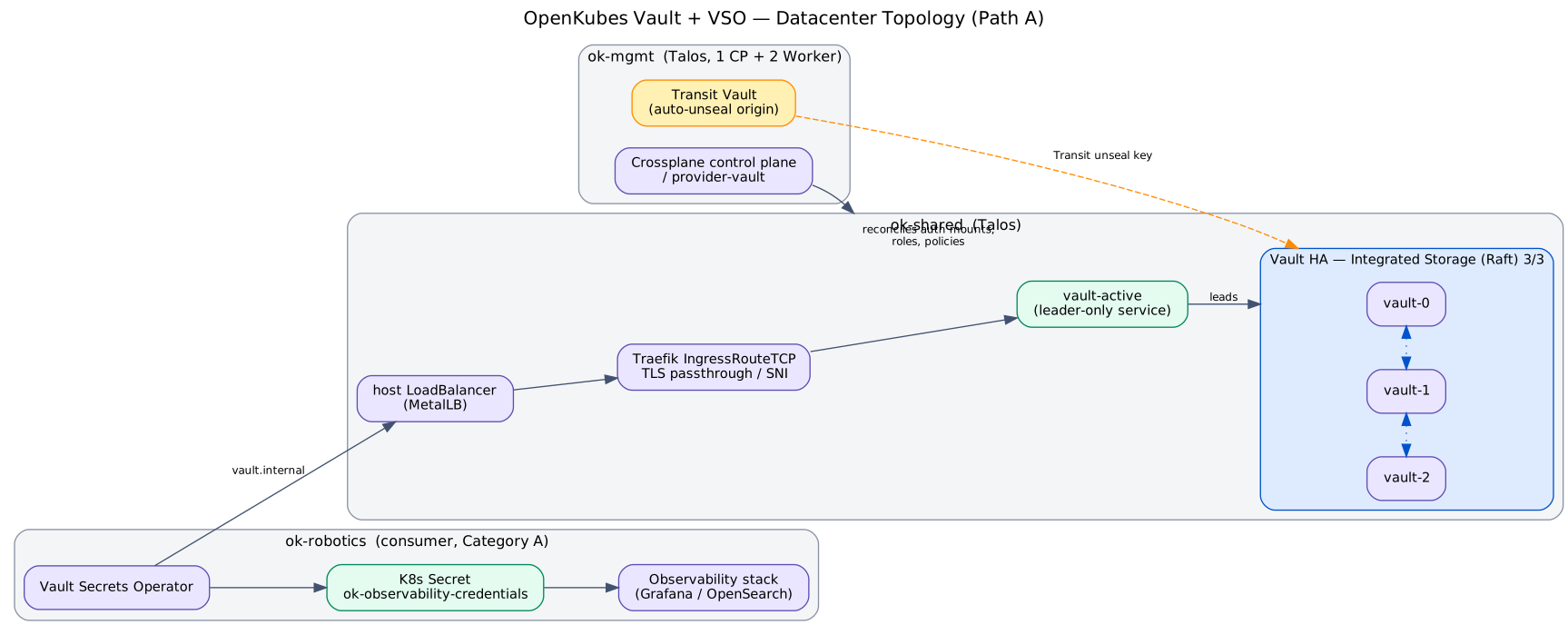
One Vault, reached over end-to-end TLS. The production Vault runs as a highly-available Raft cluster on a shared services cluster, fronted by a leader-only service. Consumers never talk to a pod directly: they dial a stable host load balancer, and Traefik passes the TCP stream straight through to the active node — TLS is never terminated in the path. The result is a single, auditable secret backend that any registered cluster can reach without bespoke per-cluster networking.
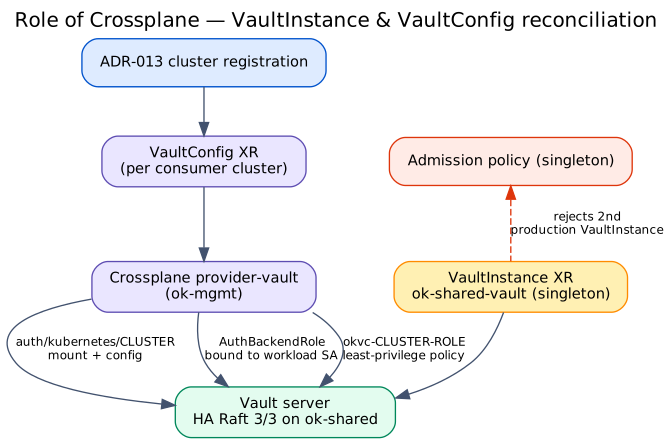
Crossplane makes the trust declarative. The interesting part isn’t installing Vault — it’s onboarding a cluster to it without hand-cranking auth mounts and policies. In OpenKubes that’s a Crossplane concern. A VaultInstance composite resource pins the central Vault as a bounded singleton — an admission policy on the management cluster rejects a second production instance outright. A per-cluster VaultConfig resource then reconciles, inside Vault, everything a new consumer needs: its own Kubernetes auth mount, a role bound to a specific workload ServiceAccount, and a least-privilege read policy scoped to just that cluster’s secret path. Registering a cluster is what onboards it to Vault — the same registration contract the rest of the platform already uses.
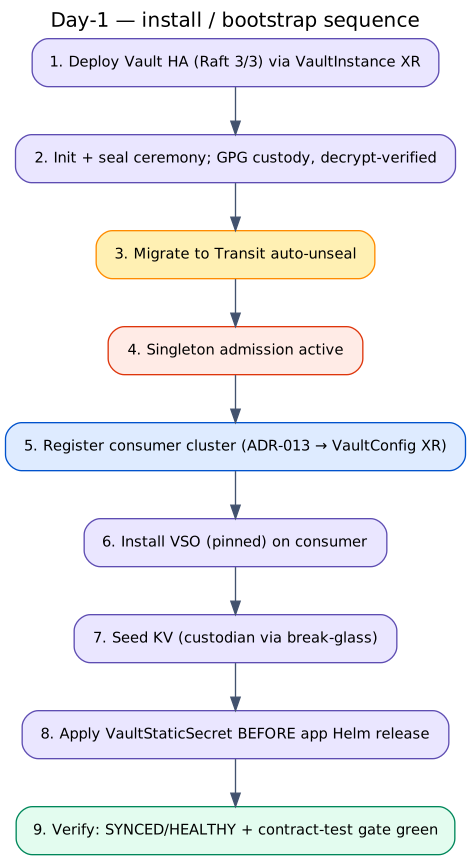
Day-1 is a sequence, not a pile of YAML. Standing the platform up follows an ordered path: deploy Vault HA, run the seal ceremony with verified custody, move the seal to unattended auto-unseal, and switch on the singleton admission guard. Onboarding a consumer is then a repeatable five-step tail: register the cluster, install VSO, seed the secret into Vault (a custodian action — the admin identity is never shared with cluster owners), and — the one ordering rule that actually bites — apply the VaultStaticSecret before the application’s Helm release, because software like OpenSearch bakes its admin password at first boot. Verify last: the operator reports the secret synced and healthy, and the capability’s contract test stays green with no chart change.
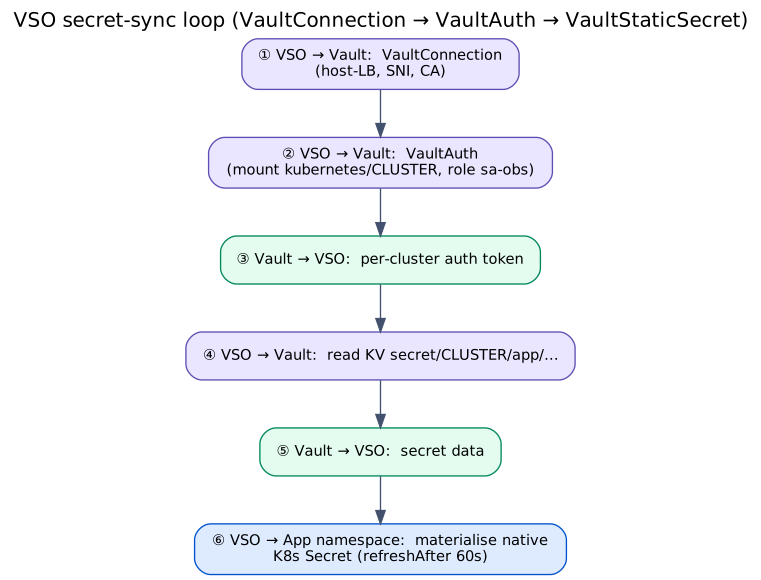
How a secret actually flows. Once wired, the loop is boring in the best way. The operator opens a connection to Vault over the host load balancer with the right SNI and CA, authenticates with its per-cluster mount and ServiceAccount-bound role, reads the one KV path its policy allows, and writes the result into the namespace as a native Kubernetes Secret — refreshing on an interval. Nothing in the application changes; it keeps reading a Secret by the same name and keys it always used. Adopting Vault is a swap underneath the contract, not a rewrite above it.
Day-2 is where a design earns its keep. Auto-unseal means a full restart recovers with no human in the loop — the cluster comes back and re-forms quorum on its own. Backups are encrypted, off-host Raft snapshots taken before every change, paired with a restore rehearsal that proves recovery through a full unseal — not merely that a snapshot file exists. Rotation is a first-class path: change the value in Vault, the operator refreshes, the native Secret updates, and targeted workloads roll to pick it up.
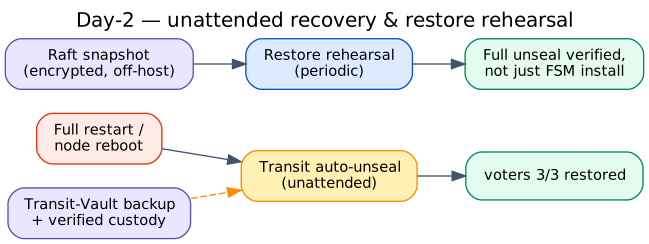
The lesson we paid for. Early on, we lost the passphrase protecting a seal-custody artifact — and discovered, the hard way, that a backup you have never decrypted is not a backup. It hardened two rules that now sit at the centre of the operating model: decrypt round-trip every custody artifact the moment you create it and again at every rehearsal; and move off attended unseal to an independently-bootstrapped auto-unseal origin, so that recovery never hinges on a single memorised secret. Neither rule is exotic. Both are the kind of thing you only truly adopt after the alternative has scared you once.
The through-line is the contract. The singleton guard, the per-cluster least-privilege policies, the “materialise before the app starts” ordering, the restore-through-unseal rehearsal — these aren’t Vault trivia. They’re the observable promises of the Secret Contract, turned into deterministic checks a machine can grade and a human can trust. The backend is replaceable; edge and offline clusters run a different profile of the very same contract. What stays constant is the shape of the promise. In OpenKubes, that’s the whole point: the contract is the guardrail — and secrets are just one more capability that has to live inside it.
Where the code lives. The datacenter Secret profile is an accepted architecture decision — ADR-Platform-025 — with the Crossplane compositions, runbooks, conformance checks and the sources for the diagrams above living under platform/secrets/vault/ in the public openkubes/openkubes repository.
Author’s note: The engineering behind this profile was carried out with Claude/Cowork and refined through a human-led three-way review involving Claude and GPT; the final editorial and architectural decisions were made by the author. Diagrams are sanitised for public use; internal endpoints and operational specifics live in the team’s runbooks.